Future trends in AI-driven marketing refer to how artificial intelligence will shape the way businesses promote products, connect with customers, and make decisions in the coming years. Instead of manual effort and broad targeting, marketing will become more automated, data-driven, and highly personalized.
Here’s a clear explanation of the key direction:
AI-driven marketing is moving toward smarter personalization, where every customer sees content tailored specifically to their interests, behavior, and preferences. At the same time, businesses will rely more on predictive analytics, meaning AI can forecast what customers are likely to buy next and when.
Another major trend is automation. Tasks like running ads, sending emails, and managing campaigns will be handled by AI systems that optimize performance in real time. This reduces human effort and improves efficiency.
We’ll also see a rise in AI-generated content, including text, images, and videos, allowing brands to produce large amounts of marketing material quickly. Along with this, chatbots and virtual assistants will become more advanced, offering instant and human-like customer interaction.
As privacy concerns grow, marketing will shift toward ethical data usage and first-party data, with AI helping businesses target customers without violating privacy rules.
Finally, technologies like voice search, visual search, and augmented reality (AR) will become more integrated with AI, creating more interactive and engaging customer experiences.
In short, the future of AI-driven marketing is about being more personalized, automated, predictive, and customer-focused.
This is the heading
Lorem ipsum dolor sit amet, consectetur adipiscing elit. Ut elit tellus, luctus nec ullamcorper mattis, pulvinar dapibus leo.
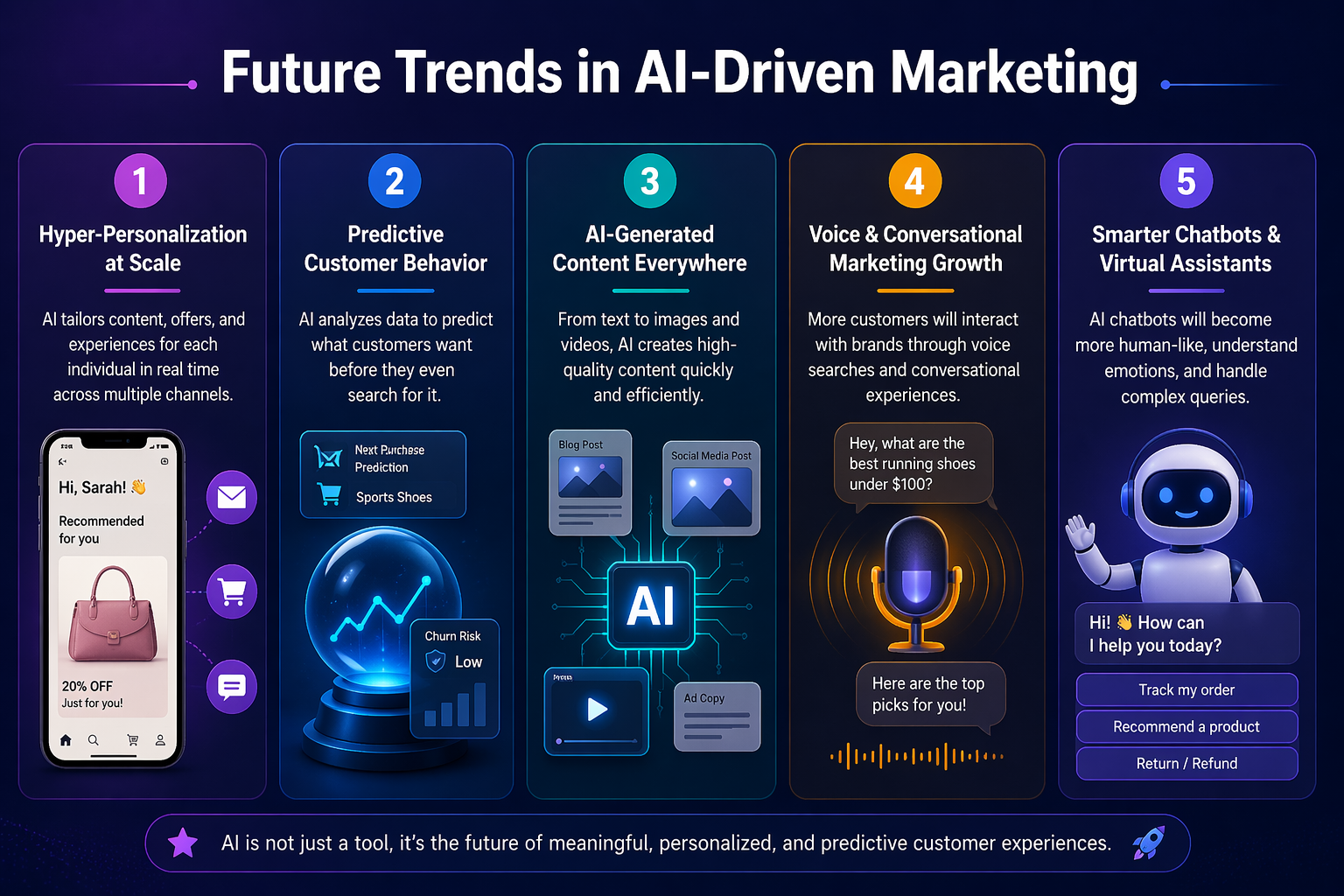
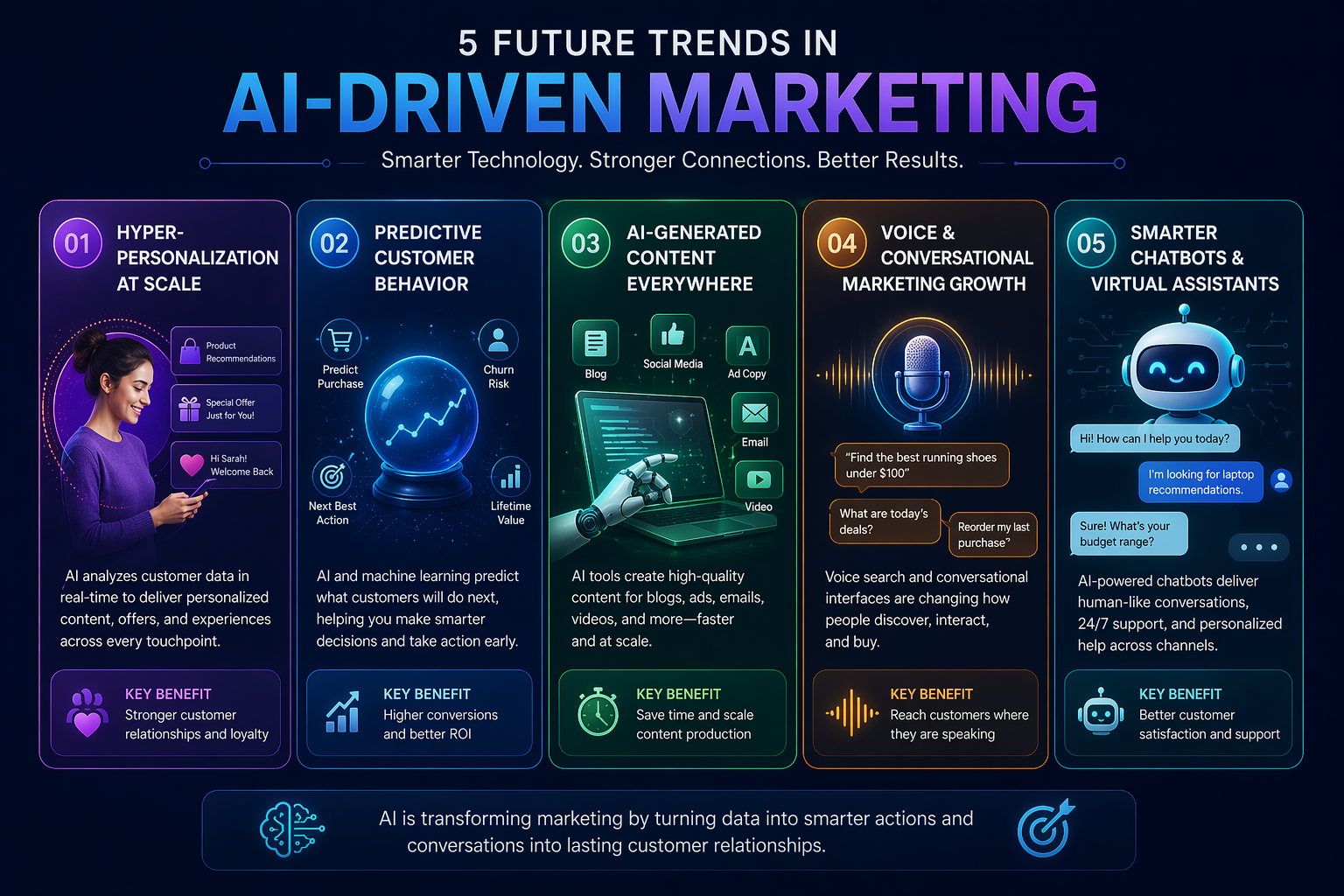
- Hyper-Personalization at Scale
AI will tailor content, ads, emails, and product suggestions for each individual user in real time. Instead of “target audiences,” brands will market to one person at a time.
- Predictive Customer Behavior
AI will predict what customers want before they even search for it—based on browsing habits, past purchases, and behavior patterns. This helps businesses act early and increase conversions.
- AI-Generated Content Everywhere
From blog posts to ad copy, videos, and images—AI tools will create high-quality content quickly. Human marketers will focus more on strategy and creativity rather than production.
- Voice & Conversational Marketing Growth
With voice assistants and chatbots improving, more marketing will happen through conversations instead of clicks—like asking a device to recommend products.
- Smarter Chatbots & Virtual Assistants
Future chatbots will feel more human, understand emotions, and handle complex customer queries—improving customer support and engagement 24/7.
- AI-Powered Ad Optimization
AI will automatically test and adjust ads (images, headlines, audience) in real time to maximize performance and reduce wasted ad spend.
- Visual & Image Recognition Marketing
AI will identify objects, faces, and scenes in images/videos, enabling new strategies like visual search (e.g., uploading a photo to find similar products).
- Privacy-Focused Marketing (Cookieless Future)
As data privacy laws increase, AI will rely more on first-party data and contextual targeting instead of third-party cookies.
- Augmented Reality (AR) + AI Experiences
AI combined with AR will let users “try before they buy” (e.g., trying clothes, furniture, makeup virtually), making online shopping more interactive.
- Automated Customer Journey Mapping
AI will track and optimize the entire customer journey—from awareness to purchase—automatically suggesting the best actions to guide users toward buying
This is the heading
Lorem ipsum dolor sit amet, consectetur adipiscing elit. Ut elit tellus, luctus nec ullamcorper mattis, pulvinar dapibus leo.