Digital marketing has become an essential part of how businesses grow and connect with people today. Whether you run a small shop, a startup, or a large company, understanding key strategies like SEO, SEM, Content Marketing, and Social Media Marketing (SMM) can make a big difference in your success. Let’s break these down in a simple, human-friendly way so you can clearly understand how they work and why they matter.
SEO (Search Engine Optimization)
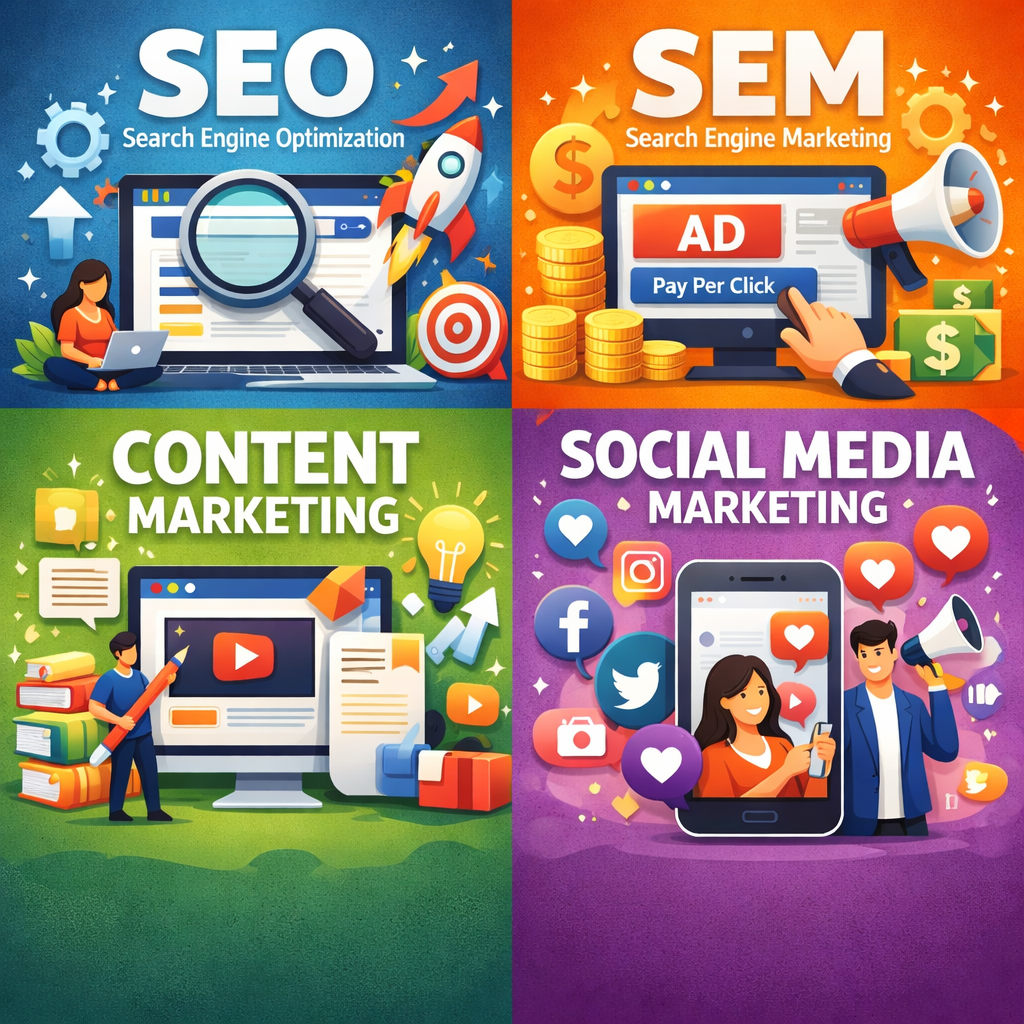
SEO is all about helping your website appear higher on search engines like Google when people search for something related to your business. Think about it—when you search for “best shoes online” or “digital marketing course,” you usually click on one of the first few results. SEO helps your website become one of those top results.
There are different parts of SEO. First is on-page SEO, which includes using the right keywords, writing useful content, and organizing your website properly. Then there’s off-page SEO, which involves getting links from other websites to build trust and authority. Lastly, technical SEO focuses on things like website speed, mobile-friendliness, and proper indexing.
SEO is not a quick process—it takes time, effort, and consistency. But once your website ranks well, it can bring free, organic traffic for a long time. That’s why SEO is often considered one of the most valuable digital marketing strategies.
SEM (Search Engine Marketing)
While SEO focuses on organic (free) traffic, SEM is about paid advertising on search engines. When you search on Google, you may notice results labeled as “Ad.” These are part of SEM.
With SEM, businesses bid on keywords so their ads appear when users search for those terms. For example, if you sell laptops, you might run ads for keywords like “buy laptop online” or “best laptop under 50000.”
The biggest advantage of SEM is speed. Unlike SEO, which takes time, SEM can bring traffic immediately. You can start getting visitors as soon as your ads go live. It’s also highly targeted—you can choose your audience based on location, interests, device, and more.
However, SEM requires a budget. You pay every time someone clicks on your ad, which is why it’s often called Pay-Per-Click (PPC) advertising. To succeed, you need to choose the right keywords, write compelling ad copy, and continuously optimize your campaigns.
Content Marketing
Content Marketing is the heart of digital marketing. It focuses on creating and sharing valuable, relevant content to attract and engage your audience. Instead of directly selling, you provide useful information that builds trust and helps people make decisions.
Content can come in many forms—blog posts, videos, infographics, podcasts, eBooks, and more. For example, if you run a fitness business, you might create blog posts about workout tips, healthy recipes, or weight loss guides.
The main goal of content marketing is to educate, inform, or entertain your audience. When people find your content helpful, they are more likely to trust your brand and eventually become customers.
Good content marketing also supports SEO. When you use the right keywords and create high-quality content, your website is more likely to rank higher in search results.
Consistency is key here. One or two pieces of content won’t make a big impact, but regular posting can build a strong online presence over time.
This is the heading
Lorem ipsum dolor sit amet, consectetur adipiscing elit. Ut elit tellus, luctus nec ullamcorper mattis, pulvinar dapibus leo.
Social Media Marketing (SMM)
Social Media Marketing is about using platforms like Instagram, Facebook, Twitter, LinkedIn, and others to promote your brand and connect with your audience. Today, billions of people use social media, making it a powerful tool for businesses.
SMM is not just about posting photos or updates—it’s about building relationships. You interact with your audience through comments, messages, likes, and shares. This helps create trust and loyalty.
Each platform has its own style. Instagram is great for visual content, LinkedIn is ideal for professional networking, and Facebook works well for community building. Businesses often use a mix of platforms to reach different audiences.
Social media also allows for paid advertising, where you can target specific groups of people based on age, location, interests, and behavior. This makes it easier to reach the right audience.
One of the biggest benefits of SMM is real-time engagement. You can instantly connect with your audience, get feedback, and adjust your strategy accordingly.