When you watch an IPL match, you may notice multiple camera angles, slow-motion replays, and graphics showing ball movement. All of this is part of the Indian Premier League camera technology, which includes high-speed cameras, sensors, and computer systems.
These cameras are placed around the stadium at different angles. Some focus on the pitch, while others track fielders, boundaries, and even crowd reactions. But beyond entertainment, these cameras help umpires make better decisions.
This is the heading
Lorem ipsum dolor sit amet, consectetur adipiscing elit. Ut elit tellus, luctus nec ullamcorper mattis, pulvinar dapibus leo.
Hawk-Eye Ball Tracking System in IPL
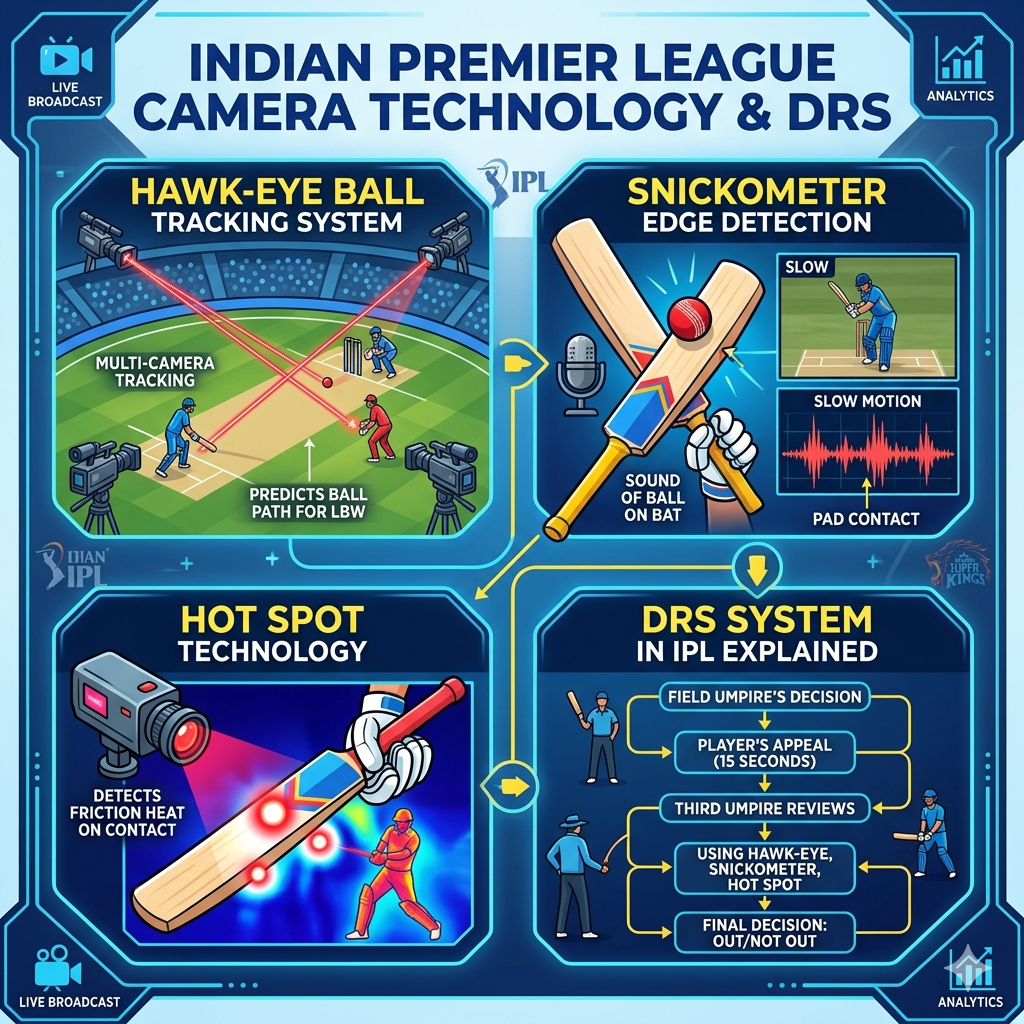
One of the most important technologies used in IPL is the Hawk-Eye. The Hawk-Eye ball tracking system IPL uses multiple cameras to follow the ball from the moment it leaves the bowler’s hand.
Here’s how it works in simple terms:
- Several cameras track the ball’s position in real time
- The system creates a 3D model of the ball’s path
- It predicts where the ball would go after hitting the batsman
This is especially useful for LBW (Leg Before Wicket) decisions. For example, if a batsman is hit on the pads, Hawk-Eye can show whether the ball would have hit the stumps.
This technology removes guesswork and helps make fair decisions, which is why it’s a key part of IPL matches.
Snickometer Edge Detection in Cricket
Another fascinating tool is the Snickometer. The Snickometer edge detection in cricket is used to check whether the ball has touched the bat.
Sometimes, edges are very faint and difficult to see with the naked eye. That’s where Snickometer helps.
It works by:
- Using sensitive microphones placed near the pitch
- Recording sound when the ball passes the bat
- Showing a graph that spikes when contact happens
If the graph shows a spike at the exact moment the ball passes the bat, it usually means there was an edge. This helps umpires decide catches behind the wicket more accurately.
Hot Spot Technology in IPL Matches
The Hot Spot is another advanced feature used in IPL. The Hot Spot technology IPL matches uses infrared cameras to detect heat generated by friction.
When the ball hits the bat or pad:
- A small amount of heat is produced
- Infrared cameras capture this heat
- A bright white spot appears on the screen
This makes it easier to confirm whether the ball made contact. Even the slightest touch can be detected using this method.
Hot Spot is especially useful when the edge is too small to be seen clearly in normal replays.
DRS System in IPL Explained
All these technologies come together under the Decision Review System. The DRS system in IPL explained simply means a process where teams can challenge the umpire’s decision.
Here’s how DRS works:
- A player or team disagrees with the umpire’s decision
- They request a review within a few seconds
- The third umpire checks multiple technologies like:
- Hawk-Eye
- Snickometer
- Hot Spot
- A final decision is made based on evidence
DRS adds fairness and reduces human error in the game. It also makes matches more exciting, as fans eagerly wait for the final decision on the big screen.
Why IPL Camera Technology is Important
The use of advanced camera systems in IPL has completely changed how cricket is played and watched.
Here are some key benefits:
- Accuracy: Decisions are more reliable
- Fair play: Reduces chances of wrong calls
- Better viewing experience: Fans enjoy detailed replays
- Transparency: Every decision is backed by data
Without these technologies, many close calls in cricket would still depend only on human judgment.
The Future of IPL Technology
As technology continues to evolve, IPL camera systems are expected to become even more advanced. Future innovations may include:
- AI-based decision making
- Real-time 3D match analysis
- Even higher frame-rate cameras
This is the heading
Lorem ipsum dolor sit amet, consectetur adipiscing elit. Ut elit tellus, luctus nec ullamcorper mattis, pulvinar dapibus leo.